
ASFPM Makes Commitment to Equity and Inclusion in Floodplain Management
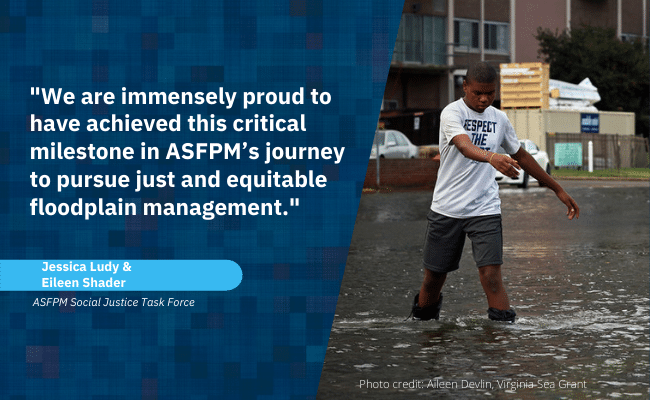
Board unanimously approves social justice policy statement
Floods are the most common, and among the most deadly, weather-related disasters in the United States. But not everyone is impacted the same way. Low-income communities and people of color shoulder a disproportionate share of the burden, and each flood event further exacerbates existing racial and social inequalities.
In an effort to ensure that all individuals at risk of flooding are treated equitably and have equal opportunity to be aware of, prepare for, respond to, and recover from floods, the ASFPM Board of Directors unanimously approved a social justice policy statement during a special meeting on Dec. 13.
The policy statement reads, in part, that, “As an organization, ASFPM will actively promote and support inclusive, equitable, and just floodplain management policies and practices at all levels of government. This approach will improve equitable outcomes so that all community members, especially those who are most vulnerable, and their needs, are represented and prioritized in our profession, practice, policy development, and decision making.”
The approval of the policy statement was celebrated by members of the ASFPM Social Justice Task Force. The task force, which drafted the policy statement and advocated for its adoption, has been meeting monthly since it was formed in July 2020 and continues to grow in numbers.
“We are immensely proud to have achieved this critical milestone in ASFPM’s journey to pursue just and equitable floodplain management, and we are thrilled to have the unanimous support of the board as we move forward,” co-chairs Jessica Ludy and Eileen Shader said in a statement. “Adoption of the policy statement is just the first step. Now the real work begins, not just for the Social Justice Task Force, but for ASFPM as a whole.”
“In the past few years, ASFPM has joined other organization in drawing attention to social justice and equity issues in our policy work and partnerships. By the adoption of this policy, ASFPM is not only affirming this critical need, but formalizing it and integrating it into how we fundamentally look at policies and programs moving forward,” said Chad Berginnis, ASFPM Executive Director. “I could not be more proud of the volunteers who worked tirelessly on this policy and the leadership of the ASFPM Board of Directors.”
At the heart of the social justice policy statement is a commitment to prioritize “social and environmental justice by examining current policies and practices in the field of floodplain management, and actively offering and promoting recommendations for changes to any that perpetuate injustices or inequities in floodplain management.”
The policy then outlines seven key ways the association will work to fulfill its obligation.
ASFPM commits to cultivating diversity, promoting equity, and fostering inclusion among our members and within the floodplain management community by:
- Developing and adopting a framework for assessing racial and socio-economic equity in our organization, and in our decision-making processes and policy positions;
- Continuing existing and establishing new partnerships with related professions, partner organizations, and impacted communities to achieve social and environmental justice in floodplain management;
- Committing to organizational learning and providing educational and training opportunities on social and environmental justice issues for ASFPM members
- Listening to, learning from, amplifying, and working with socially vulnerable communities that are disproportionately impacted by floods;
- Supporting increased accessibility of flood related communication in languages and media formats to meet the needs of socially vulnerable communities;
- Supporting and promoting policy changes that will result in more equitable distribution of flood-related financial resources and mitigation benefits;
- Promoting solutions that consider, assess, and engage vulnerable populations where social or environmental justice may be an issue.
Social justice going forward
Now that the board has approved the social justice policy statement, the task force will turn its attention to creating short- and long-term work plans to help prioritize efforts, Ludy and Shader said. Among the key initiatives are: writing a policy paper with recommendations for addressing inequities in floodplain management, fostering organizational learning on social and environmental justice issues for ASFPM members; adding a social justice task force page to ASFPM’s website; and working with the committees, executive office, board, and other entities within ASFPM to integrate equity and justice in ASFPM’s work.
Indeed, on the day the statement was approved, Steve Samuelson, vice chair of the board, reached out to committee co-chairs to provide them with a copy of the policy statement and encouraged them to think about how the seven items listed should best influence their committee work going forward.
